|
|
Ibero-American
Journal of Psychology and Public Policy |
Review Article January 2026 | Volume 3 | Number 1 |

Systematic review on the use of heuristics in the election of candidates for public office
(Revisión sistemática del uso de heurísticos en la elección de candidatos a cargos públicos)
Carlos Ascencio-Garrido
School of Psychology, Universidad Católica Silva Henríquez, Chile;
cascenciog@ucsh.cl 
|
Reference: Ascencio-Garrido, C. (2026). Systematic review on the use of heuristics in the election of candidates for public office (Revisión sistemática del uso de heurísticos en la elección de candidatos a cargos públicos). Ibero-American Journal of Psychology and Public Policy, 3(1), 15-40. https://doi.org/10.56754/ Editor: Ricardo
Jorquera, Universidad de Atacama, Chile Reception date: 28 Mar 2025 Acceptance date: 12 Nov 2025 Publication date: 28 Jan 2026 Language: English and Spanish Translation: Helen Lowry Publisher’s Note: IJP&PP remains neutral with regard to jurisdictional claims in published maps and institutional affiliations.
Copyright: © 2026 by the author. This article is an open access article distributed under the terms and conditions of the Creative Commons Attribution (CC BY NC SA) license (https://creativecommons.org/licenses/by-nc-sa/4.0/). |
Abstract: The study of decision heuristics is a field of research for both political psychology and disciplines such as political science and economics, particularly since the theoretical models of Lau and Redlawsk. To establish a theoretical background that would allow for the development of lines of research in the Latin American context, a systematic review of scientific production associated with the last 20 years was conducted. This systematic review used a procedure guided by the PRISMA model, in indexed databases, yielding a total of 42 articles published between 2000 and 2020. The results show a wide variety of heuristics investigated and an interesting group of cues not considered in theoretical models, with quantitative and qualitative methodological strategies that justify the construction of appropriate research models to explore the use of heuristics in different types of elections. There is a clear need to investigate the use of heuristic cues and the use of strategies as separate concepts in a differentiated manner. Likewise, the possibility of investigating the combined behavior of heuristics in particular political contexts, especially in multiparty democracies, is established. Keywords: decision-making; cognitive shortcuts; Lau and Redlawsk model; multiparty elections; PRISMA systematic review. Resumen: El estudio de los heurísticos de decisión es un campo de investigación tanto para la psicología política como para disciplinas como la ciencia política y la economía, en particular desde los modelos teóricos de Lau y Redlawsk. Para poder sentar antecedentes teóricos que permitan construir líneas de investigación en el contexto latinoamericano, se realizó una revisión sistemática de la producción científica asociada a los últimos 20 años. Se llevó a cabo una revisión sistemática mediante un procedimiento guiado por el modelo PRISMA, en bases de datos indexadas, con lo que se obtuvo un total de 42 artículos publicados entre 2000 y 2020. Los resultados muestran una gran variedad de heurísticos investigados y un grupo novedoso de claves no consideradas en los modelos teóricos, con estrategias metodológicas cuantitativas y cualitativas que permiten justificar la construcción de modelos de investigación apropiados para explorar el uso de heurísticos en diferentes tipos de elecciones. Se constata la necesidad de investigar de manera diferenciada el uso de claves heurísticas y el uso de estrategias como conceptos separados. Asimismo, se establece la posibilidad de investigar el comportamiento combinado de heurísticos en contextos políticos particulares, en especial en democracias multipartidistas. Palabras clave: toma de decisiones; atajos cognitivos; Modelo de Lau y Redlawsk; elecciones multipartidistas; revisión sistemática PRISMA. Resumo: O estudo dos heurísticos de decisão é um campo de investigação tanto para a psicologia política como para disciplinas como a ciência política e a economia, em particular a partir dos modelos teóricos de Lau e Redlawsk. A fim de estabelecer antecedentes teóricos que permitam construir linhas de investigação no contexto latino-americano, foi realizada uma revisão sistemática da produção científica associada aos últimos 20 anos. Foi realizada uma revisão sistemática, por meio de um procedimento guiado pelo modelo PRISMA, em bases de dados indexadas, obtendo-se um total de 42 artigos publicados entre 2000 e 2020. Os resultados mostram uma grande variedade de heurísticas pesquisadas e um grupo interessante de chaves não consideradas nos modelos teóricos, com estratégias metodológicas quantitativas e qualitativas que permitem justificar a construção de modelos de pesquisa apropriados para explorar o uso de heurísticas em diferentes tipos de eleições. Constata-se a necessidade de investigar de forma diferenciada o uso de chaves heurísticas e o uso de estratégias como conceitos separados. Da mesma forma, estabelece-se a possibilidade de investigar o comportamento combinado de heurísticas em contextos políticos específicos, especialmente em democracias multipartidárias. Palavras-chave: tomada de decisões; atalhos cognitivos; Modelo de Lau e Redlawsk; eleições multipartidárias; revisão sistemática PRISMA.
|



1. Introduction
Voting is a behavior that requires a great deal of cognitive effort, where the person organizes information about the importance of voting, the prominence of the candidates, or the social agenda. All of these issues are filtered by the press, social media, and one's own experience, background knowledge, and motivation (Ditonto, 2019). It is a task where individuals must maximize their reasoning skills to make a politically coherent decision that correctly expresses their preferences, interests, or ideologies, which is referred to as the right vote (Lewkowicz, 2006).
There is a broad consensus that voting is paradoxical, where people, even those with low levels of background knowledge, can vote efficiently, maintaining high levels of consistency and stability in political systems (Lau & Redlawsk, 2001, 2006). Different models have addressed this issue, demonstrating a preference for explanations that span sociological to rational choice models (Rivera & Jaráiz, 2016).
From a cognitive perspective, voting is a problem-solving situation in which the methods people use to process information and the strategies or cues they use to maximize their decision are crucial. These are defined as heuristics, cues, and biases in political thought (Pétry & Duval, 2017).
Heuristics is understood as cues or strategies for decision-making derived from experience and used to optimize the use of available information when making decisions with limited information (García-Retamero & Dieckmann, 2006; Lau et al., 2018; Lewkowicz, 2006; Robles, 2005; Tóth & Chytilek, 2018). Traditional research assumes that the use of these cues is particularly common in people with low levels of background or political knowledge (Ryan, 2010; Van der Straeten et al., 2010). However, some authors regard them as tools that can be used broadly by both experts and non-experts, with the difference lying in the efficiency of the use of heuristic cues and the quality of the information obtained from them (Bernhard & Freeder, 2020; Lauener, 2020).
According to Lau and Redlawsk's (2001) theoretical model, the main decision heuristics in voting are the candidate's party, the beliefs they express on issues of interest to the voter, their viability or position in the polls, their appearance, and the support they have (Lau, 2013; Lau & Redlawsk, 2001; Milic, 2020). Additionally, other studies consider the comparative performance of neighboring countries, expectations of future gains, and the assessment of the current government’s economic performance as heuristics (Erdoğan, 2013; Hansen et al., 2015).
The first of these heuristics, the candidate's political party, is considered the most frequently used and least costly cue, which should provide the most information, as it can summarize the candidate's beliefs and ideology (Lau & Redlawsk, 2006; McDermott, 2009; Schaffner & Streb, 2002). In this sense, it is linked to the cues associated with the candidate's ideology and the presence of public supporters or endorsers. Second, the candidate's stated beliefs are considered to be in accordance with the voter's preferences, known as issue voting (Redlawsk, 2004).
The third heuristic is the candidate's viability, which provides key information regarding the cost and benefit of voting. This serves as a cue that guides the decision between voting for a preferred candidate (expressive vote) or voting for a less preferred candidate to avoid an undesirable alternative (strategic vote; Marietta & Barker, 2007). The fourth heuristic cue, endorsement, refers to the public support the candidate has, something widely used in referendums where the exposure of figures or institutions can guide the decision (Lewkowicz, 2006; Stevens & Banducci, 2013).
The last of the heuristics identified in the model is the candidate's appearance. This cue indicates that people consider aspects such as image, attractiveness, beauty, voice, and, to a lesser extent, social background, religion, and demographic background, as useful cues for decision-making when voting (Banducci et al., 2008; Berggren et al., 2017; McLaughlin & Wise, 2014; Pavela Banai et al., 2017; Stockemer & Praino, 2015). This point is often considered in conditions of information poverty and is presumed to be used more by voters with limited familiarity (Carnes & Lupu, 2016; Carnes & Sadin, 2015).
As can be seen from the points discussed above, the variety of information sources and associated heuristic cues in Lau and Redlawsk's (2001) model allows for varied research on the topic, with different approaches to one or more of these heuristic strategies or cues. These approaches involve the use of predictive methodologies, aggregate data analysis, category identification based on qualitative analysis, and even cross-country comparisons. Nevertheless, there is little integrated evidence or systematization of studies that accounts for the results of studies in recent years. This need involves reviewing aspects that facilitate a comprehensive understanding of the study of these cues, including the methods of data extraction and the types of analyses performed, as well as proposing avenues of research that consider how information is obtained and processed, thus expanding the scope of possible studies and theoretical approaches in this field.
Integrating these studies offers an overview of the state of research on these mental processes, highlighting the methods used, the levels of analysis in the different studies, and even the relevance of the heuristics considered, as well as the potential to include additional cues not previously considered in the study of political choices.
What is the methodological, conceptual, and analytical status of research on this topic? To answer this question, a systematic review is proposed that will serve as both a report and a foundation for the aforementioned elements.
2. Objectives
To synthesize the results and methodologies of international studies conducted since 2000 on voters' use of different heuristic cues in their voting decisions according to the model developed by Lau and Redlawsk (2001).
The specific objectives of this research involve a) identifying the main heuristics studied in international research; b) describing the methodologies and levels of analysis used in the studies reviewed; and c) describing the main trends and possible lines of research based on the studies reviewed.
3. Method
3.1. Design
A literature review was conducted in five databases (Web of Science, Scopus, Proquest, Science Direct, and Ebsco). Although both Scopus and Science Direct belong to the same publisher (Elsevier), the former returns different and more numerous results when the search codes are applied. These databases allow users to access internationally oriented research, with Scopus providing broader coverage and WoS offering greater selectivity and impact (Singh et al., 2021). In contrast, Science Direct, Ebsco, and Proquest allow users to search more specific and regional databases in the field of social sciences.
For the concept of heuristics, the following terms were used in the search of the abstracts: heuristics and cues, using the connector OR. The term bias was omitted because it included research associated with cognitive biases unrelated to the use of heuristic cues in voting decisions. The following terms were used to refer to voting behavior: vote, voting, voting behavior, and election. Wildcards (*) were used to ensure broader coverage in the search for related studies.
3.2 Inclusion criteria
The following inclusion/exclusion criteria for the review were used in accordance with the PRISMA model criteria (Moher et al., 2009):
1. Studies on the election of representatives, both in presidential elections and in legislative or local elections.
2. That the variables involved referred to decision heuristics, both cues and strategies.
3. That the dependent variable was voting intention (both under conditions of actual manipulation of independent variables and in predictive contexts).
4. Experimental, quasi-experimental, or non-experimental designs with a correlational or explanatory scope.
3.3 Coding of the studies
The information search was conducted by the author; therefore, no indicators of agreement between coders are available or reported. The coding process was conducted based on the following characteristics:
1. general data,
2. heuristics analyzed,
3. objectives of the study,
4. methodology,
5. design, and
6. type of analysis.
4. Results
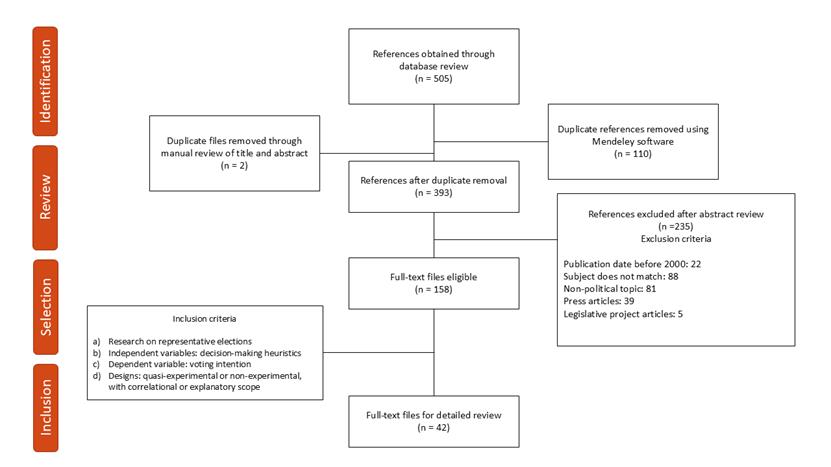
Figure 1 provides a summary of the procedure for searching and selecting articles for this study. This concludes with the selection of the 42 articles to perform the proposed analysis and description.
Figure 1
Flow chart of article selection for systematic review
The 42 articles selected for this analysis are detailed in Table 1. The following pages present a breakdown of the results obtained from the analysis. First, the results of the descriptive analysis are presented, followed by an analysis of the methods used in the studies reviewed and, finally, an analysis of the heuristics used, following the model of Lau and Redlawsk (2001).
4.1 Descriptive analysis
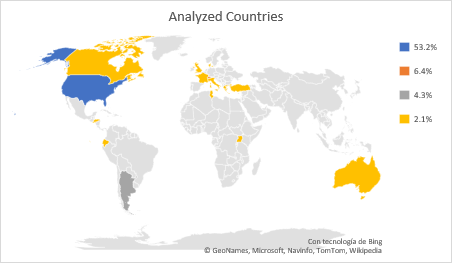
Based on the results shown in Table 1, studies predominantly come from the United States (53.2%), followed by international research, with comparative studies between the UK, the US, and Argentina standing out. In the case of exclusively Latin American research, Ecuador, El Salvador, Honduras, and Argentina itself are of note.
The predominance of US-based studies is linked to the larger volume of Anglophone scholarship, which provides access to extensive electoral survey databases. It is also related to the complexity of the electoral system, which includes positions of varying importance at the county, regional, state, and national levels across such areas as the judiciary, the legislature, and the presidency (Barth et al., 2019; Bernhard & Freeder, 2020). A descriptive graph on this point is provided in Figure 2.
Table 1
Studies included in the review
|
Study |
Heuristics analyzed |
Region/Country |
Sample |
Data type |
Type of analysis |
|
Schaffner and Streb (2002) |
Party |
USA |
Not reported |
Secondary |
Logistic regression |
|
McDermott (2005) |
Candidate’s occupation |
USA |
1,659 voters |
Secondary |
Logistic regression |
|
Matson and Fine (2006) |
Others |
USA |
255 candidates |
Secondary |
Logistic regression |
|
Marietta and Barker (2007) |
Beliefs |
USA |
287 |
Primary |
Probit model regression |
|
Chiao et al. (2008) |
Appearance |
USA |
73 |
Primary |
Multiple linear regression |
|
Calvo et al. (2009) |
Ballot design |
Argentina |
Not reported |
Secondary |
Logistic regression |
|
Navarrete et al. (2010) |
Ethnic background |
USA |
62 (study 1) and 224 (study 2) |
Primary |
Logistic regression |
|
Ryan (2010) |
Networks |
USA |
1,551 |
Simulated |
Logit model regression |
|
Van der Straeten et al. (2010) |
Strategy |
Canada-Paris |
734 |
Primary |
Percentage of correct predictions |
|
Abakoumkin (2011) |
Others |
Greece |
853 candidates |
Secondary |
Logistic regression |
|
Franklin and Van Spanje (2012) |
Party |
Italy |
Not reported |
Secondary |
Logistic regression |
|
Graefe and Armstrong (2012) |
Strategy |
USA |
Not reported |
Secondary |
Logistic regression |
|
Spezio et al. (2012) |
Appearance |
USA |
61 participants |
Primary |
Correlations |
|
Erdoğan (2013) |
Party |
Türkiye |
900 |
Primary |
Logistic regression |
|
McLaughlin and Wise (2014) |
Religion |
USA |
520 |
Primary |
Logistic regression |
|
Hansen et al. (2015) |
Comparative performance |
Denmark |
2,078 |
Primary |
Logistic regression |
|
Stockemer and Praino (2015) |
Appearance |
USA |
2,400 |
Primary |
Anova |
|
Carnes and Sadin (2015) |
SEL |
USA |
Exp. 1: 380, Exp. 2: 663 |
Primary |
t-tests for comparing means |
|
Carnes and Lupu (2016) |
SEL |
UK - USA - ARG |
N= 7,558 (GB), 1,356 (USA), 2,000 (ARG) |
Secondary |
t-tests for comparing means |
|
Conroy-Krutz et al. (2016) |
Party |
Uganda |
429 |
Primary |
Logistic regression |
|
Ditonto (2017) |
Gender |
USA |
826 |
Primary |
Anova |
|
Pavela Banai et al. (2017) |
Appearance |
International |
51 pares de candidates |
Primary |
Logistic regression |
|
Stockemer and Praino (2017) |
Appearance |
Australia |
456 |
Primary |
Logistic regression |
|
Ono and Burden (2019) |
Gender |
USA |
1,583 |
Primary |
Average marginal component effect (AMCE) |
|
Robbett and Matthews (2018) |
Party |
USA |
627 |
Primary |
Logistic regression |
|
Badas and Stauffer (2019) |
Gender, Party |
USA |
2,274 voters |
Secondary |
Logistic regression |
|
Barth et al. (2019) |
Ethnic background |
USA |
Not reported |
Secondary |
Logistic regression |
|
Harteveld et al. (2019) |
Party |
International |
86,811 |
Secondary |
Logistic regression |
|
Webster and Pierce (2019) |
Edad |
USA |
55,400 |
Secondary |
Logistic regression |
|
Anderson et al. (2020) |
Ethnic background |
USA |
1,485 |
Primary |
Logistic regression |
|
Berinsky et al. (2020) |
Ethnic background |
USA |
3,173 |
Primary |
t-tests for comparing means |
|
Cunha Silva and Crisp (2020) |
Gender |
Ecuador, El Salvador, and Honduras |
7,585 |
Secondary |
Logistic regression |
|
Dobbs (2020) |
Age |
Tunisia |
1,000 |
Primary |
Multiple linear regression |
|
Griffin et al. (2020) |
SEL |
USA |
5,258 |
Primary |
t-tests for comparing means |
|
Lauener (2020) |
Strategy |
Switzerland |
Not reported |
Secondary |
Logistic regression |
|
Milic (2020) |
Endorsement |
Switzerland |
13,500 |
Secondary |
Logistic regression |
|
Bernhard and Freeder (2020) |
Strategy |
USA |
3,678 |
Primary |
Logistic regression |
|
Adams et al. (2021) |
Candidate’s occupation |
USA |
7,947 candidates |
Secondary |
Logistic regression |
|
Portmann (2022) |
Candidate’s experience |
Switzerland |
1,844 candidates |
Secondary |
Logistic regression |
|
Kang and Song (2023) |
Order of voting, ballot design, and ideology |
South Korea |
38,497 |
Primary |
Multiple linear regression |
|
Vilaça and Turner (2024) |
Candidate’s occupation |
Brazil |
1,052 |
Primary |
Joint analysis |
|
Engelbrecht et al. (2024) |
Ethnic background |
USA |
549 |
Primary |
Logistic regression |
Note. In all cases, except for the studies by Ditonto (2017), Berinsky et al. (2020), and Matson and Fine (2006), the samples consist of voters.
Figure 2
Geographic location of the samples analyzed
Another noteworthy point derived from Table 1 is the predominance of party as the most analyzed heuristic (15.6%), followed by ethnic background, appearance (11.1% each), and gender (8.9%). Importantly, there is also a significant number of studies involving heuristic decision-making strategies, such as the Take the Best heuristic or analyzing the use of more than one cue in a particular political context (Graefe & Armstrong, 2012). These studies were grouped under the strategy code, which accounted for 8.9% of the total, as illustrated in Figure 3.
Figure 3
Type of heuristic analyzed in the studies

An important point to note is that, as shown in Figure 3, heuristics not considered in the Lau and Redlawsk (2001) model, such as the candidate’s ethnic background, appear in studies on the use of this cue in Afro-descendant and Latino candidates (Anderson et al., 2020; Berinsky et al., 2020). The candidate's socioeconomic level is also analyzed, which is seen as a kind of class vote in the case of candidates from working class backgrounds (Adams et al., 2021; Carnes & Lupu, 2016; Carnes & Sadin, 2015; Griffin et al., 2020), and both the candidate's age and experience, which may be a group cue possibly used by voters (Dobbs, 2020; Portmann, 2022; Webster & Pierce, 2019).
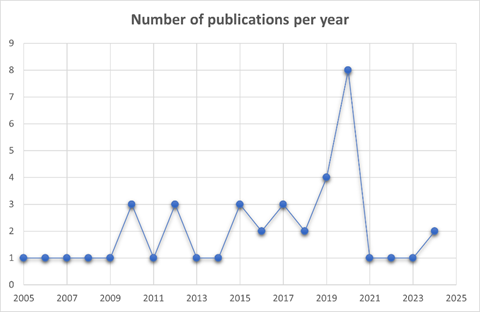
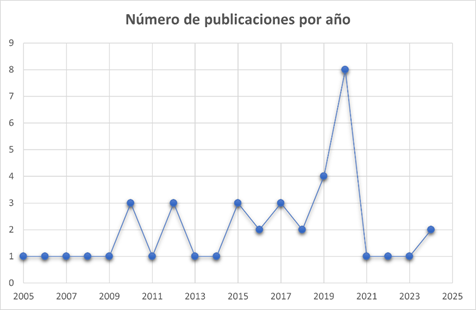
In terms of publication year, Figure 4 shows an increase in research volume up to 2020, the year of the presidential elections in the US, when Donald Trump lost to Joe Biden. When combining this information with the type of heuristic analyzed, the most recent studies notably deal with the most novel cues, such as ethnic background, gender, and socioeconomic level (Berinsky et al., 2020; Cunha Silva & Crisp, 2020; Dobbs, 2020; Engelbrecht et al., 2024; Vilaça & Turner, 2024), suggesting an expansion of the model and its applications in various elections beyond the traditional ones. However, after 2020, the number of studies decreased considerably, including such heuristics as the candidate’s occupation, design, and ethnic background (Engelbrecht et al., 2024; Kang & Song, 2023; Vilaça & Turner, 2024).
Figure 4
Number of studies per year (2002-2024)
Concerning the type of data analysis, Table 2 shows that this is largely performed using predictive association statistics, where regressions, and in particular logistic regressions, are predominantly used regardless of whether the studies are experimental or non-experimental. To a much lesser extent, analyses such as analysis of variance and comparison of means are also included.
Table 2
Type of data analysis
|
Type of instrument |
|
Frequency: |
|
% Total |
|
Logistic regression |
26 |
|
63.4 % |
|
|
t-tests for comparing means |
4 |
|
9.8 % |
|
|
Multiple linear regression |
3 |
|
7.3 % |
|
|
Analysis of variance |
2 |
|
4.9 % |
|
|
Logit model regression |
1 |
|
2.4 % |
|
|
Probit model regression |
1 |
|
2.4 % |
|
|
Percentage of correct predictions |
1 |
|
2.4 % |
4.2 Analysis of methods
Most studies claim to use secondary data, making indirect explanatory inferences. The main consequence of such strategies is that evidence of a correlation between the cue and the survey or election outcome does not guarantee that the latter results from heuristic information processing, but rather from a link between a predictor and an electoral result.
Conversely, it is possible to find experimental studies that modify aspects of the candidate to bring about changes in heuristic processing in the people who participate. The availability of primary data allows for greater flexibility in methods, irrespective of the need for causal links that studies on heuristics and voting decisions may have (Berinsky et al., 2020; Griffin et al., 2020; Rice & Barth, 2016; Robbett & Matthews, 2018).
4.3 Analysis of the heuristics used
The political party is the main heuristic cue examined, considering different contexts or types of elections. In the UK and the US, it is taken as a precedent in two-party elections, whereas in studies conducted in countries like Argentina, Uganda, and Italy, the multiparty system considers this heuristic cue as a way of ruling out those parties or coalitions not preferred by the voter. None of the reported studies makes any comparison among these political systems; therefore, the differential functioning of this heuristic remains unknown. The analyses performed in Italy and Uganda are novel because they assess the effectiveness of this cue in democracies with relatively new party systems (Moehler & Conroy-Krutz, 2016).
One of the most important conclusions from the analysis of the candidate’s political party heuristic is that it is a highly parsimonious one, widely used in low‑information election contexts and by voters with limited analytical capacity (Erdoğan, 2013; Schaffner & Streb, 2002). It is so relevant that it is even used under conditions where it is not useful or provides irrelevant information (Franklin & van Spanje, 2012; Moehler & Conroy-Krutz, 2016). It is also a filter that influences other heuristic strategies, such as the retrospective assessment of a government or strategic/sincere voting; therefore, its importance as a heuristic and its hierarchy should be high. The lack of these cues may result in confusion and an increase in “erroneous” voting, with political knowledge serving as the only variable that moderates this effect.
However, as previously mentioned, categories of heuristics have emerged in recent years that are not mentioned in the Lau and Redlawsk (2001) model and are idiosyncratic to American culture. Here, ethnicity as a decision-making cue is a new and rather specific element of the analysis that emerges in the study of these electorates (Anderson et al., 2020; Barth et al., 2019; Berinsky et al., 2020). It must be considered that ethnic background is understood very broadly, with a rather vague definition similar to the notion of ethnicity, with the most typical case being the electorate of Latin American origin.
Other heuristics that have emerged in the last decade are gender, age, and socioeconomic level. The first of these is studied in relation to the traditional underrepresentation of women in politics, with some results finding it to be a mediator in party use (Badas & Stauffer, 2019; Ditonto, 2017; Ono & Burden, 2019). Another important gender-related aspect is its interaction with the perception of competence, where the positive image of highly preferred female candidates leads to a transfer of characteristics to their fellow candidates on the same list (Cunha Silva & Crisp, 2020).
In the case of socioeconomic level, studies indicate that voters do not necessarily consider a candidate's background to be relevant information (Carnes & Lupu, 2016; Carnes & Sadin, 2015; McDermott, 2009), using it mainly to evaluate the quality of the candidate, but not to influence their voting decision. A similar pattern emerges with age as a decision-making cue; however, this heuristic is used far more frequently by older adults, whereas it appears to be largely absent among younger individuals.
In the case of appearance-related heuristic cues, studies have been published that consider attractiveness a predominant decision heuristic (Stockemer & Praino, 2015, 2017). However, other elements such as voice and overall appearance also emerge, these being novel elements beyond facial features (Chiao et al., 2008; Spezio et al., 2012).
5. Discussion
When reviewing and analyzing the results obtained, it is possible to question whether these studies pertain to heuristics or rather employ heuristics as predictors, which would fail to differentiate them from studies that use social class or attitudes as predictors of voting behavior. Indeed, there is no genuine questioning of whether heuristics are actually used as predictors in decision-making; rather, it is assumed to be an already proven scientific fact. The objective, therefore, is not to scrutinize the theoretical framework of such a model, but to apply it to explaining social phenomena (Franklin & van Spanje, 2012).
This is particularly relevant, given that the assumption that heuristics function as cognitive shortcuts under conditions of informational scarcity is not actually proven in the case of political cues, let alone in the specific context of Chilean political culture. In this sense, it cannot be said that the use of heuristics is necessarily negative without knowing how they work differently among Chilean voters. This has particular implications for public policy design, as policies could be developed based on knowledge applicable in cultures where the use of heuristics such as tone of voice (understood as a racial origin cue) does not necessarily align with a culture like Chile's, where political prejudices may be more socially rather than racially motivated.
5.1 Recommendations for action
The need to explore the use of heuristic cues as informative indicators, rather than cognitive shortcuts, may enable the formulation of public policies that emphasize the appropriate use of the cues most commonly employed by the Chilean population and the avoidance of those cues or strategies that lead to biased voting based on distorted or malicious information. It is essential to emphasize the ethical need for culturally valid information so that it can serve as a suitable resource for those designing civic education programs.
In this light, further research is needed to explore the construction of the decision-making process, heuristic or not, at the moment of voting. This type of effort involves different methodologies and epistemological perspectives, which should enable a comprehensive and specific understanding of how voters decide how to vote and use these strategies as a means of achieving a satisfactory vote.
The implications that knowledge on this subject may have for public policy design are extensive. These include both the creation of civic education campaigns designed to promote the proper use of available decision-making strategies and cues and the implementation of targeted efforts to curb the spread of fake news and smear campaigns that distort electoral processes and undermine confidence in the democratic system and its institutions.
5.2 Limitations and future directions
Focusing on heuristics as the main topic of analysis opens up several avenues worth exploring in future research. First, the opportunity to review heuristics as decision-making cues that can be organized and used in alignment with strategies arising from experience. In this context, examining multiple heuristics within a particular election collectively can provide an interesting contribution to the existing body of knowledge on the subject.
Similarly, considering the five cues identified by Lau and Redlawsk (2001) in addition to some categories that have emerged from studies conducted over the last decade represents a broad field of enquiry that may be of interest in the field of political psychology. Studies in this context make it possible to understand both the frequency of use and the hierarchy and, in the context of mixed methodologies, the significance and shared social construction of these elements as aspects of political identity.
Another option involves studying heuristic strategies, which are not dependent on the above-mentioned cues. Heuristics like Take the best, recognition heuristics, or strategic voting can be integrated into the study in a way that complements the heuristic cues described by Lau and Redlawsk (2001). The possibility of studying the conditions of frugality and speed, characteristic of the models proposed by Gigerenzer, Todd, and Selten (Gigerenzer et al., 2000; Gigerenzer & Selten, 2001), can shed light on the political decision-making styles of Chilean voters. This becomes particularly relevant when comparing different types of elections. Some elections offer varied and in-depth sources of information, high media exposure of candidates, and strong citizen interest. Others, by contrast, are marked by scarce, incomplete, or even inconsistent information, limited media exposure of candidates, and a lower perceived importance, which reduces voters’ incentive to seek information proactively (Dancey & Sheagley, 2013).
Given the limited number of studies on decision heuristics in candidate elections, as evidenced by the results of this study, it is somewhat redundant to highlight areas for further research, such as the combination of decision cues or innovation in the methods for presenting voting decisions. However, it should be noted that the study of this type of process is strongly influenced by the electoral context in which it is studied.
Here, the differences between elections of greater significance, such as presidential or legislative elections, and those of lesser social relevance, such as municipal elections (and, where applicable, mayoral or gubernatorial elections), condition not only the content of the methodological models that can be used, but also the very nature of the strategies and, ultimately, the epistemological justification that can be advanced in this regard.
Far from being a disadvantage, this is an attractive feature of a field that can be approached from different research perspectives, producing knowledge and participatory intervention at various levels, which opens up the field to several different lines of inquiry. Nevertheless, it should be pointed out that an initial approach could be descriptive, particularly in the field of the use of heuristics in simulated elections. Obtaining specific information on the use and prioritization of particular strategies and cues in elections, such as presidential elections, is a necessary first step to establishing subsequent lines of research that delve more deeply into the generation, organization, and differential functioning of these strategies in the contexts described in the preceding paragraphs.
It is therefore possible to propose a line of research that explores the use of such cues and strategies that can be carried out under laboratory conditions, and that establishes the use and the hierarchy that can be assigned to heuristics without specifying any particular one. This implies a methodological innovation that would allow for laboratory experiments in which the task of choosing a candidate is subject to an active information search, guided by the decision-making cues and strategies available. This type of design also facilitates the study of the interaction among the available decision-making heuristics, an undoubtedly valuable contribution, given that such an analysis is largely absent from most of the studies reviewed, which typically focus on only one or two decision-making cues or heuristic strategies.
It should be noted that this research is limited to the election of political representatives. This conditions the proposals and guides the analysis in a direction that is neither exclusive nor unique to the field of politics and voting. It becomes clear on closer examination that the results do not apply to studies associated with referendums or political votes by specific actors, such as legislators or members of local governments. This would aid in expanding the theoretical and practical scope of analysis and application, while also leaving open the possibility of contributions from the specific contexts of countries with different political models.
6. Conclusions
This article is an effort to lay the theoretical and practical foundations for possible studies on the use of political decision heuristics in light of the theoretical model of Lau and Redlawsk (2001) in the Chilean electoral context. There is a broad and diverse landscape of development at the international level, which reveals opportunities for replication at the local level as well as the feasibility of contributing innovative methodologies or approaches to this issue.
In general, the heuristics proposed in the aforementioned model are used in isolation for study purposes, with some novel elements emerging in specific social contexts, such as tone of voice, appearance, and social background. The combination of cues and their hierarchy is an area where future studies can contribute significantly, defining and perfecting the theory and refining its application in different countries or election types.
It is to be expected
that the results presented here will serve as a useful point of reference,
particularly for researchers seeking to enter this specific field of political
inquiry and thus generate knowledge that can support the application of public policies
that promote the responsible use of information by voters in Chilean and Latin
American democracies.
Revisión sistemática del uso de heurísticos en elección de candidatos a cargos públicos
1. Introducción
El voto es una conducta que requiere una gran cantidad de esfuerzo cognitivo, donde la persona organiza información acerca de la importancia de la votación, la saliencia de los candidatos o la agenda temática social. Todo lo anterior se encuentra filtrado por los medios de prensa, por las redes sociales y por la propia experiencia, sofisticación y motivación sobre la misma (Ditonto, 2019). Se trata de una tarea en la que la persona debe maximizar su capacidad de razonamiento para poder tomar una decisión que sea políticamente coherente y que exprese de manera correcta sus propias preferencias, intereses o ideologías, lo cual se le denomina voto correcto (Lewkowicz, 2006).
Existe un amplio consenso en cuanto a que en el voto se da una situación paradojal, donde las personas, aun poseyendo niveles bajos de sofisticación, son capaces de votar de manera eficiente, manteniendo niveles altos de coherencia y estabilidad en los sistemas políticos (Lau & Redlawsk, 2001, 2006). Ello ha sido abordado por diferentes modelos, los cuales han mostrado preferencia por explicaciones que van desde modelos sociológicos a modelos de elección racional (Rivera & Jaráiz, 2016).
Desde una mirada cognitiva, el voto es una situación de resolución de problemas, en la cual adquieren importancia las maneras con las cuales las personas procesan la información y las estrategias o claves que utilizan para maximizar la decisión. Estas son definidas como heurísticos de decisión (heuristics), claves (cues) y sesgos (biases) en el pensamiento político (Pétry & Duval, 2017).
Los heurísticos pueden ser entendidos como claves o estrategias para la toma de decisiones, que surgen de la experiencia y son utilizados de tal forma que las personas maximizan la información disponible para tomar una decisión con información limitada (García-Retamero & Dieckmann, 2006; Lau et al., 2018; Lewkowicz, 2006; Robles, 2005; Tóth & Chytilek, 2018). La investigación tradicional supone que el uso de estas claves es particularmente frecuente en personas con bajo nivel de sofisticación o conocimiento político (Ryan, 2010; Van der Straeten et al., 2010). No obstante, existen autores que los consideran de uso general tanto en expertos como en inexpertos, donde la diferencia se daría en cuanto a la eficiencia del uso de claves heurísticas y a la calidad de la información obtenida a partir de ellas (Bernhard & Freeder, 2020; Lauener, 2020).
De acuerdo con el modelo teórico de Lau y Redlawsk (2001), los principales heurísticos de decisión en el voto son el partido del candidato, las creencias que este manifiesta en temas de interés del elector, la viabilidad o posición en encuestas, la apariencia y los apoyos que posea el candidato (Lau, 2013; Lau & Redlawsk, 2001; Milic, 2020). Adicionalmente, otras investigaciones consideran como heurísticos el desempeño comparativo de países vecinos, la expectativa de ganancia futura y la evaluación del gobierno actual en el campo económico (Erdoğan, 2013; Hansen et al., 2015).
El primero de estos heurísticos —el partido político del candidato— es considerado como la clave más recurrente y menos costosa, que debería aportar mayor cantidad de información, siendo capaz de resumir las creencias y la ideología del candidato (Lau & Redlawsk, 2006; McDermott, 2009; Schaffner & Streb, 2002). En ese sentido, se vincula con las claves asociadas a la ideología del candidato y a la presencia de apoyos públicos o endorsers. En segundo lugar, se encuentran las creencias manifiestas del candidato, las cuales son consideradas de acuerdo con las preferencias del votante, algo conocido como issue voting (Redlawsk, 2004).
El tercer heurístico es la viabilidad del candidato, la cual entrega información clave respecto del costo y beneficio que tiene el acto de votar. Esto es usado como una clave que permite la decisión entre votar por un candidato de preferencia (voto expresivo), o bien, votar por un candidato menos deseable, pero que evita una opción desagradable (voto estratégico; Marietta & Barker, 2007). La cuarta clave heurística, el endorsement, hace referencia a los apoyos públicos que tenga el candidato, algo que es muy utilizado en referéndums donde la exposición que tengan las figuras o instituciones puede guiar la decisión (Lewkowicz, 2006; Stevens & Banducci, 2013).
El último de los heurísticos señalados en el modelo es la apariencia del candidato. Esta clave indica que las personas consideran aspectos como la imagen, el atractivo, la belleza, la voz y, en menor medida, el origen social, la religión y los antecedentes demográficos, como claves útiles para la toma de decisiones en el voto (Banducci et al., 2008; Berggren et al., 2017; McLaughlin & Wise, 2014; Pavela Banai et al., 2017; Stockemer & Praino, 2015). Este punto es frecuentemente considerado en condiciones de pobreza informativa y se presume que es utilizado en mayor medida por votantes con bajos niveles de sofisticación (Carnes & Lupu, 2016; Carnes & Sadin, 2015).
Como puede desprenderse de lo expuesto anteriormente, la variedad de las fuentes informativas y de las claves heurísticas asociadas en el modelo de Lau y Redlawsk (2001) permiten que la investigación respecto del tema sea variada y con distintos enfoques acerca de una o varias de estas estrategias o claves heurísticas. Estos enfoques implican la utilización de metodologías predictivas, análisis de datos agregados, levantamiento de categorías desde análisis cualitativo e incluso la comparación entre países. Pese a lo anterior, existe escasa evidencia integrada o sistematización de investigaciones que den cuenta de los resultados de los estudios en los últimos años. Esta necesidad implica la revisión de aspectos que permitan una visión amplia del estudio de estas claves, lo cual incluye la forma en que se extraen los datos y los tipos de análisis que se realizan con ellos y proponer líneas de investigación que consideren la forma en que se obtiene y procesa la información, ampliando el margen de estudios y alcances teóricos posibles en este campo.
La integración de estas investigaciones puede dar cuenta del estado del arte en el estudio de estos procesos mentales, mostrar una panorámica sobre los métodos utilizados, los niveles de análisis en las distintas investigaciones e incluso la pertinencia de los heurísticos considerados o la posibilidad de incorporar otras claves que no hayan sido contempladas con anterioridad, para el estudio de las elecciones políticas.
¿Cuál es el estado metodológico, conceptual y analítico de las investigaciones sobre este tema? Para responder esta pregunta, se propone la realización de una revisión sistemática que sirva de reporte y sustento sobre los elementos antes mencionados.
2. Objetivos
Sintetizar los resultados y metodologías de investigaciones internacionales realizadas desde el año 2000, sobre el uso que tienen los votantes de las diferentes claves heurísticas, según el modelo de Lau y Redlawsk (2001), en la decisión de voto.
Los objetivos específicos de esta investigación implican a) Identificar los principales heurísticos estudiados en investigaciones internacionales; b) Describir las metodologías y los niveles de análisis utilizados en los estudios revisados y c) Describir las principales tendencias y posibles líneas de investigación a partir de los estudios revisados.
3. Método
3.1 Diseño
Se realizó una revisión de literatura en cinco bases de datos (Web of Sciences, Scopus, Proquest, Science Direct y Ebsco). Pese a que tanto Scopus como Science Direct pertenecen al mismo proveedor editorial (Elsevier), se pudo comprobar que los códigos de búsqueda arrojan resultados diferentes y más numerosos en la primera de estas bases. Estas bases de datos permiten encontrar investigaciones que tengan alcance internacional, con un mayor alcance en el caso de Scopus y una mayor selectividad e impacto para el caso de WoS (Singh et al., 2021). Por otro lado, Science Direct, Ebsco y Proquest permiten una búsqueda en bases de datos más específicas y regionales en el campo de las ciencias sociales.
Para el concepto de heurísticos, se utilizaron los siguientes términos en la búsqueda dentro de los resúmenes de las investigaciones: heuristics y cues, utilizando el conector OR. Se dejó fuera el término de bias (sesgo) dado que incluía investigaciones asociadas con sesgos cognitivos que no tenían relación con el uso de claves heurísticas de decisión de voto. Para la conducta de voto se utilizaron los términos: vote, voting, voting behavior y election. Se utilizaron comodines (*) para asegurar un mayor alcance en la búsqueda de investigaciones asociadas.
3.2 Criterios de inclusión
Los criterios de inclusión/exclusión de la revisión fueron utilizados siguiendo los criterios del modelo PRISMA (Moher et al., 2009), quedando de la siguiente manera:
1. Investigaciones acerca de elecciones de representantes, tanto en elecciones presidenciales como en elecciones legislativas o locales.
2. Que las variables involucradas fueran referidas a heurísticos de decisión, tanto claves o como estrategias.
3. Que la variable dependiente fuera la intención de voto (tanto en condiciones de manipulación real de variables independientes como en predicción).
4. Diseños experimentales, cuasi experimentales o no experimentales, con un alcance correlacional o explicativo
3.3 Codificación de las investigaciones
La búsqueda de información fue realizada por el autor, por lo cual no se disponen o reportan indicadores de acuerdo entre codificadores. El proceso de codificación se realizó en función de las siguientes características:
1. datos generales,
2. heurísticos analizados,
3. objetivos de la investigación,
4. metodología,
5. diseño, y
6. tipo de análisis.
4. Resultados
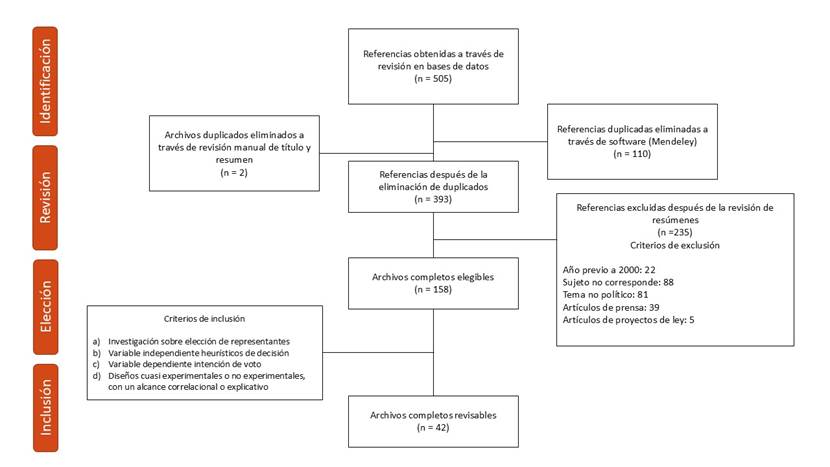
En la Figura 1 se puede ver el resumen del procedimiento de búsqueda y selección de artículos para la presente investigación. Este concluye con la selección de los 42 artículos con los cuales se realizarán el análisis y la descripción propuestos.
Figura 1
Flujo de la selección de artículos para la revisión sistemática
Los 42 artículos seleccionados para el presente análisis se pueden ver desglosados en la Tabla 1. En las siguientes páginas se desglosan los resultados alcanzados luego del análisis. En primer lugar, se exponen los resultados del análisis descriptivo, para posteriormente dar cuenta del análisis de los métodos utilizados en las investigaciones en estudio y por último, un análisis sobre los heurísticos utilizados, siguiendo el modelo de Lau y Redlawsk (2001).
4.1 Análisis descriptivo
A partir de los resultados expuestos en la Tabla 1 se puede observar una predominancia de las investigaciones en Estados Unidos (53,2%), seguida de investigaciones a nivel internacional donde destacan estudios comparados entre Inglaterra, EE. UU. y Argentina; y en el caso de investigaciones exclusivamente latinoamericanas, Ecuador, El Salvador, Honduras y la misma Argentina.
Tabla 1
Investigaciones incluidas en la revisión
|
Heurístico(s) analizado(s) |
Región/País |
Muestra |
Tipo de datos |
Tipo de análisis |
|
|
Schaffner y Streb (2002) |
Partido |
EE.UU. |
No reporta |
Secundarios |
Regresión logística |
|
McDermott (2005) |
Ocupación del candidato |
EE.UU. |
1.659 votantes |
Secundarios |
Regresión logística |
|
Matson y Fine (2006) |
Otros |
EE.UU. |
255 candidatos |
Secundarios |
Regresión logística |
|
Marietta y Barker (2007) |
Creencias |
EE.UU. |
287 |
Primarios |
Regresión modelo probit |
|
Chiao et al. (2008) |
Apariencia |
EE.UU. |
73 |
Primarios |
Regresión lineal múltiple |
|
Calvo et al. (2009) |
Diseño del voto |
Argentina |
No informa |
Secundarios |
Regresión logística |
|
Navarrete et al. (2010) |
Ascendencia étnica |
EE.UU. |
62 (estudio 1) y 224 (estudio 2) |
Primarios |
Regresión logística |
|
Ryan (2010) |
Redes |
EE.UU. |
1.551 |
Simulados |
Regresión modelo logit |
|
Van der Straeten et al. (2010) |
Estrategia |
Canadá-Paris |
734 |
Primarios |
porcentaje de predicciones correctas |
|
Abakoumkin (2011) |
Otros |
Grecia |
853 candidatos |
Secundarios |
Regresión logística |
|
Franklin y Van Spanje (2012) |
Partido |
Italia |
No informa |
Secundarios |
Regresión logística |
|
Graefe y Armstrong (2012) |
Estrategia |
EE. UU. |
No reporta |
Secundarios |
Regresión logística |
|
Spezio et al. (2012) |
Apariencia |
EE. UU. |
61 participantes |
Primarios |
Correlaciones |
|
Erdoğan (2013) |
Partido |
Turquía |
900 |
Primarios |
Regresión logística |
|
McLaughlin y Wise (2014) |
Religión |
EE. UU. |
520 |
Primarios |
Regresión logística |
|
Hansen et al. (2015) |
Desempeño comparado |
Dinamarca |
2.078 |
Primarios |
Regresión logística |
|
Stockemer y Praino (2015) |
Apariencia |
EE. UU. |
2.400 |
Primarios |
Anova |
|
Carnes y Sadin (2015) |
NSE |
EE. UU. |
Exp. 1: 380, Exp. 2: 663 |
Primarios |
Pruebas t de comparación de medias |
|
Carnes y Lupu (2016) |
NSE |
GB - EE. UU. - ARG |
N= 7.558 (GB), 1.356 (EE. UU.), 2.000 (ARG) |
Secundarios |
Pruebas t de comparación de medias |
|
Conroy-Krutz et al. (2016) |
Partido |
Uganda |
429 |
Primarios |
Regresión logística |
|
Ditonto (2017) |
Género |
EE. UU. |
826 |
Primarios |
Anova |
|
Pavela Banai et al. (2017) |
Apariencia |
Internacional |
51 pares de candidatos |
Primarios |
Regresión logística |
|
Stockemer y Praino (2017) |
Apariencia |
Australia |
456 |
Primarios |
Regresión logística |
|
Ono y Burden (2019) |
Género |
EE. UU. |
1.583 |
Primarios |
Average marginal component effect (AMCE) |
|
Robbett y Matthews (2018) |
Partido |
EE. UU. |
627 |
Primarios |
Regresión logística |
|
Badas y Stauffer (2019) |
Género, Partido |
EE. UU. |
2.274 votantes |
Secundarios |
Regresión logística |
|
Barth et al. (2019) |
Ascendencia étnica |
EE. UU. |
No reporta |
Secundarios |
Regresión logística |
|
Harteveld et al. (2019) |
Partido |
Internacional |
86.811 |
Secundarios |
Regresión logística |
|
Webster y Pierce (2019) |
Edad |
EE. UU. |
55.400 |
Secundarios |
Regresión logística |
|
Anderson et al. (2020) |
Ascendencia étnica |
EE. UU. |
1.485 |
Primarios |
Regresión logística |
|
Berinsky et al. (2020) |
Ascendencia étnica |
EE. UU. |
3.173 |
Primarios |
Pruebas t de comparación de medias |
|
Cunha Silva y Crisp (2020) |
Género |
Ecuador, El Salvador y Honduras |
7.585 |
Secundarios |
Regresión logística |
|
Dobbs (2020) |
Edad |
Túnez |
1.000 |
Primarios |
Regresión lineal múltiple |
|
Griffin et al. (2020) |
NSE |
EE. UU. |
5.258 |
Primarios |
Pruebas t de comparación de medias |
|
Lauener (2020) |
Estrategia |
Suiza |
No informa |
Secundarios |
Regresión logística |
|
Milic (2020) |
Endorsement |
Suiza |
13.500 |
Secundarios |
Regresión logística |
|
Bernhard y Freeder (2020) |
Estrategia |
EE. UU. |
3.678 |
Primarios |
Regresión logística |
|
Adams et al. (2021) |
Ocupación del candidato |
EE. UU. |
7.947 candidatos |
Secundarios |
Regresión logística |
|
Portmann (2022) |
Experiencia del candidato |
Suiza |
1.844 candidatos |
Secundarios |
Regresión logística |
|
Kang y Song (2023) |
Orden del voto, diseño del voto e ideología |
Corea del Sur |
38.497 |
Primarios |
Regresión lineal múltiple |
|
Vilaça y Turner (2024) |
Ocupación del candidato |
Brasil |
1.052 |
Primarios |
Análisis conjunto |
|
Engelbrecht et al. (2024) |
Ascendencia étnica |
EE. UU. |
549 |
Primarios |
Regresión logística |
Nota. En todos los casos, salvo las investigaciones de Ditonto (2017), Berinsky et al. (2020) y Matson y Fine (2006), las muestras indican personas votantes.
La predominancia de las investigaciones norteamericanas se asocia con una mayor producción anglosajona, lo que genera la disponibilidad de amplias bases de datos de encuestas electorales y de la complejidad del sistema electoral, el cual involucra puestos de importancia variada a nivel de condado, regional, estatal y nacionalmente, en ámbitos diversos tales como judicatura, legislación y presidencia (Barth et al., 2019; Bernhard & Freeder, 2020). Una gráfica descriptiva sobre este punto puede verse en la Figura 2.
Figura 2
Localización geográfica de las muestras analizadas

Otro punto destacado derivado de la Tabla 1 es la predominancia del partido como heurístico más analizado (15,6%), seguido de la ascendencia étnica, la apariencia (11,1% cada uno) y el género (8,9%). Resulta también importante indicar que existe un número importante de investigaciones que involucran estrategias heurísticas de decisión, tales como el heurístico Take the best o el análisis del uso de más de una clave en un contexto político particular (Graefe & Armstrong, 2012). Estas investigaciones fueron agrupadas en el código de estrategias, que obtuvo un 8,9% de presencia, como se puede ver en la Figura 3.
Figura 3
Tipo de heurístico analizado en las investigaciones
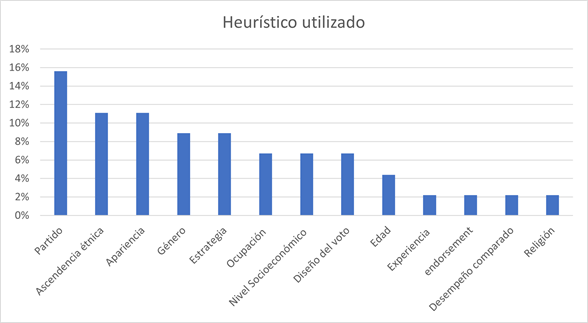
Un punto importante de señalar es que, como muestra la Figura 3, aparecen heurísticos no considerados en el modelo de Lau y Redlawsk (2001), tales como la ascendencia étnica del candidato, en investigaciones acerca del uso de esta clave en candidatos afrodescendientes y latinos (Anderson et al., 2020; Berinsky et al., 2020). También se analiza el nivel socioeconómico del candidato, el cual es visto como una especie de voto de clase en el caso de candidatos de origen obrero (Adams et al., 2021; Carnes & Lupu, 2016; Carnes & Sadin, 2015; Griffin et al., 2020) y tanto la edad como la experiencia del candidato, las cuales se pueden usar como una clave de grupo que posiblemente pueda ser utilizada por los votantes (Dobbs, 2020; Portmann, 2022; Webster & Pierce, 2019).
En cuanto al año de publicación, la Figura 4 permite apreciar un aumento del volumen investigativo hasta el año 2020, año de las elecciones presidenciales en EE. UU. donde Donald Trump pierde contra Joe Biden. Al combinar esta información con el tipo de heurístico analizado, se puede observar que las investigaciones más recientes tratan acerca de aquellas claves también más novedosas, tales como ascendencia étnica, género y nivel socioeconómico (Berinsky et al., 2020; Cunha Silva & Crisp, 2020; Dobbs, 2020; Engelbrecht et al., 2024; Vilaça & Turner, 2024), lo cual sugiere una ampliación del modelo y sus aplicaciones en diversas elecciones más allá de las tradicionales. No obstante, posterior al año 2020 el número de investigaciones decrece considerablemente, incluyendo heurísticos tales como ocupación del candidato, el diseño y la ascendencia étnica (Engelbrecht et al., 2024; Kang & Song, 2023; Vilaça & Turner, 2024).
Figura 4
Número de investigaciones por año (2002-2024)
En relación con el tipo de análisis de
datos, la Tabla 2 muestra que estos se realizan en gran medida por medio de
estadísticos de asociación predictiva, donde las regresiones y, en particular,
las regresiones logísticas, son mayormente utilizadas tanto si las
investigaciones son de carácter experimental como no experimental. De manera
mucho más marginal, aparecen análisis como Análisis de varianza y la
comparación de medias.
Tabla 2
Tipo de análisis de datos
|
Tipo de instrumento |
|
Frecuencia |
|
% Total |
|
Regresión logística |
26 |
|
63,4 % |
|
|
Pruebas t de comparación de medias |
4 |
|
9,8 % |
|
|
Regresión lineal múltiple |
3 |
|
7,3 % |
|
|
Análisis de varianza |
2 |
|
4,9 % |
|
|
Regresión modelo logit |
1 |
|
2,4 % |
|
|
Regresión modelo probit |
1 |
|
2,4 % |
|
|
Porcentaje de predicciones correctas |
1 |
|
2,4 % |
4.2 Análisis sobre los métodos
La mayor parte de las investigaciones declara utilizar datos secundarios, realizando inferencias explicativas que son de carácter indirecto. La principal consecuencia de este tipo de estrategias es que la evidencia de una correlación entre la clave y el resultado de la encuesta o la elección no garantiza que esta última sea resultado de un procesamiento heurístico de la información, sino más bien de un vínculo entre un antecedente y un resultado electoral.
Por otro lado, es posible encontrar investigaciones experimentales que modifican aspectos del candidato para provocar cambios en el procesamiento del heurístico en las personas que participan. La presencia de datos primarios permite una mayor flexibilidad en los métodos, independientemente de la necesidad de vinculación causal que puedan tener las investigaciones acerca de los heurísticos y la decisión de voto (Berinsky et al., 2020; Griffin et al., 2020; Rice & Barth, 2016; Robbett & Matthews, 2018).
4.3 Análisis sobre los heurísticos utilizados
El partido político es la principal clave de estudio investigada, considerando diferentes contextos o tipos de elección. En Inglaterra y EE. UU. es tomado como antecedente en elecciones bipartidistas, mientras que, en investigaciones realizadas en países como Argentina, Uganda o Italia, el sistema multipartidista considera esta clave heurística como una forma de descartar aquellos partidos o coaliciones que no son de la preferencia del votante. Ninguna de las investigaciones reportadas realiza algún tipo de comparación entre estos sistemas políticos, por lo que se desconoce el funcionamiento diferencial de este heurístico, pero resulta novedoso el análisis que se realiza en Italia y Uganda, evaluando la capacidad que tiene esta clave en democracias con sistemas partidistas relativamente nuevos (Moehler & Conroy-Krutz, 2016).
Una de las conclusiones más importantes del análisis del heurístico partido político del candidato es que este se trata de un heurístico de gran parsimonia y muy utilizado en contextos de elecciones de baja información y en votantes con escasa capacidad de análisis (Erdoğan, 2013; Schaffner & Streb, 2002). Es tan relevante que incluso es utilizado en condiciones en las cuales no sirve, o bien, entrega información no relevante (Franklin & van Spanje, 2012; Moehler & Conroy-Krutz, 2016). Se trata también de un filtro que influye en otras estrategias heurísticas, tales como la evaluación retrospectiva de un gobierno o en el voto estratégico/sincero, por lo que su importancia como heurístico y su jerarquía debieran ser altas. La ausencia de estas claves puede producir confusión y un aumento del voto “erróneo”, siendo la sofisticación política la única variable que modera dicho efecto.
Ahora bien, como se adelantó previamente, en los últimos años han emergido categorías de heurísticos no señaladas en el modelo de Lau y Redlawsk (2001) y que son idiosincráticas a la cultura norteamericana. Aquí, la etnia como clave de decisión es un elemento nuevo y más bien específico del análisis que surge en el estudio de estos electorados (Anderson et al., 2020; Barth et al., 2019; Berinsky et al., 2020). Hay que considerar en este caso que la ascendencia étnica es entendida de una manera muy amplia, con una definición bastante imprecisa y más bien similar a la noción de etnia, siendo el caso más típico el del electorado de origen latinoamericano.
Otros heurísticos que emergen en la última década son el género, la edad y el nivel socioeconómico. El primero de ellos es estudiado en relación con la subrepresentación tradicional de las mujeres en política, encontrándose algunos resultados como un mediador en el uso del partido (Badas & Stauffer, 2019; Ditonto, 2017; Ono & Burden, 2019). Otro aspecto importante asociado al género es la interacción que posee con la percepción de competencia, donde la imagen positiva de candidatas de alta preferencia produce un traspaso de características a sus compañeras de lista (Cunha Silva & Crisp, 2020).
En el caso del nivel socioeconómico, hay investigaciones que señalan que el votante considera la proveniencia del candidato como una información no necesariamente relevante (Carnes & Lupu, 2016; Carnes & Sadin, 2015; McDermott, 2009), siendo utilizado principalmente para evaluar la calidad del candidato, pero no la decisión de voto. Algo parecido ocurre con la edad como clave decisional, pero con la salvedad de que este heurístico es usado con mayor frecuencia en personas mayores, en comparación con los jóvenes, en quienes no parece estar presente.
En el caso de las claves heurísticas asociadas a la apariencia, se pueden reportar investigaciones que consideran el atractivo como un heurístico de decisión preponderante (Stockemer & Praino, 2015, 2017). Pero también aparecen otros elementos como la voz y el aspecto general, siendo estos elementos novedosos al considerar elementos distintos del rostro (Chiao et al., 2008; Spezio et al., 2012).
5. Discusión
Al revisar los resultados obtenidos y su forma de análisis, es posible cuestionar si efectivamente se trata de investigaciones referidas a los heurísticos, o bien, se trata de investigaciones que usan los heurísticos como predictor, lo cual no las distinguiría de estudios que utilicen la clase social o las actitudes como predictores de la conducta de voto. En efecto, no se aprecia un cuestionamiento real acerca de si los heurísticos son utilizados realmente como antecedentes de la decisión, sino que más bien se da por supuesto que ello es un hecho científico ya probado. La pretensión, entonces, no es el cuestionamiento teórico de un modelo de esta naturaleza, sino más bien la aplicación de este a la explicación de fenómenos sociales (Franklin & van Spanje, 2012).
Esto es especialmente relevante, dado que el supuesto del uso de heurísticos como atajos mentales en condiciones de precariedad informativa, no queda probado en el caso de las claves políticas, mucho menos en el contexto particular de la cultura política chilena. En este sentido, no se puede afirmar que el uso de heurísticos sea necesariamente negativo sin conocer su funcionamiento diferencial en la población de votantes chilenos y chilenas. Esto tiene especial implicancia en el diseño de políticas públicas, ya que éstas podrían ser elaboradas a partir de conocimiento válido en culturas donde el uso de heurísticos como el tono de voz (entendido como clave de origen racial), no se condice necesariamente con una cultura como la chilena, donde los prejuicios políticos pueden ser más de origen social que racial.
5.1 Recomendaciones para la acción
La necesidad de explorar el uso de las claves heurísticas como indicadores informativos, más que como atajos mentales, puede permitir la fundamentación de políticas públicas que enfaticen un uso apropiado de las claves más usadas en la población chilena y la evitación de aquellas claves o estrategias que conduzcan a un voto sesgado, a partir de información tergiversada o maliciosa. Es imprescindible destacar la necesidad ética de contar con información culturalmente válida, para poder servir de fuentes de información apropiadas para quienes diseñan programas de educación cívica.
Dado lo anteriormente expuesto, es necesaria la realización de investigaciones que exploren la construcción del proceso decisional, sea este heurístico o no, en el momento del voto. Este tipo de esfuerzos involucra metodologías y perspectivas epistemológicas diferentes, las cuales deberían permitir llegar a una comprensión global y particular de la manera en que las y los votantes deciden el voto y utilizan estas estrategias como medios para lograr un voto satisfactorio.
Las implicancias que un conocimiento sobre este tema puede tener para el diseño de políticas públicas son extensas. Desde la posibilidad de elaborar campañas de educación ciudadana, que orienten el correcto uso de las estrategias y las claves de decisión disponibles, como la focalización de estrategias que combatan la proliferación de las fake news y campañas de difamación que enturbian los procesos electorales y minan la confianza en el sistema democrático y sus instituciones.
5.2 Limitaciones y líneas futuras
Cuando nos centramos en los heurísticos como tema principal de análisis, emerge una serie de opciones que pudieran ser de interés en su estudio. En primer lugar, la posibilidad de revisar los heurísticos como claves de decisión que pueden ser ordenadas y utilizadas por las personas, de acuerdo con estrategias surgidas de la experiencia. En ese escenario, el estudio de múltiples heurísticos en una elección particular, de manera combinada, puede ser un aporte interesante al conocimiento en torno al tema.
De igual modo, considerar las cinco claves señaladas por Lau y Redlawsk (2001), agregando algunas categorías que emergen de las investigaciones realizadas en el último decenio, constituye un campo de investigación extenso y de posible interés en el espectro de la psicología política. Estudios en este escenario permiten conocer tanto la frecuencia del uso como la jerarquización y, en el contexto de metodologías mixtas, la significación y la construcción social compartida de estos elementos como aspectos de la identidad política.
Otra opción implica el estudio de las estrategias heurísticas, las cuales no son dependientes de las claves señaladas anteriormente. Heurísticos como Take the best, el heurístico de reconocimiento o el voto estratégico pueden ser integrados al estudio de forma complementaria a las claves heurísticas descritas por Lau y Redlawsk (2001). La posibilidad de estudiar las condiciones de frugalidad y rapidez, propias de los modelos de Gigerenzer, Todd y Selten (Gigerenzer et al., 2000; Gigerenzer & Selten, 2001) puede dar luces respecto de los estilos de toma de decisión política que tienen los votantes chilenos, particularmente si se comparan los tipos de elecciones diferentes, desde aquellas que poseen fuentes de información variada y profunda, con una alta exposición mediática de los candidatos y un fuerte interés ciudadano, hasta aquellas donde la información es precaria, incompleta e incluso incoherente, con una menor exposición mediática de los candidatos y donde la menor importancia relativa de las votaciones incide en la motivación de los electores para buscar información de manera activa (Dancey & Sheagley, 2013).
Dado que el número de estudio acerca de heurísticos de decisión en elecciones por candidatos es más bien limitado, como puede verse en el resultado de la presente investigación, resulta en parte redundante señalar que existen campos donde la investigación puede ser profundizada, como la combinación de claves de decisión o la innovación en los métodos de presentación de las tareas de decisión de voto. Pero es necesario indicar que el estudio de este tipo de procesos está fuertemente condicionado por el contexto electoral en el cual se estudie.
Aquí las diferencias entre las elecciones de mayor trascendencia como las elecciones presidenciales o legislativas y las elecciones de menor relevancia social las municipales (y eventualmente las elecciones de intendentes o gobernaciones), condicionan no solamente el contenido de los modelos metodológicos que se puedan utilizar, sino también la naturaleza misma de las estrategias y eventualmente la justificación epistemológica que pueda darse al respecto.
Esto, lejos de ser una desventaja, constituye un atractivo para un campo que puede ser abordado desde diferentes sensibilidades investigativas, generando conocimiento e intervención participativa en distintos niveles, lo cual abre campo para varias líneas diferentes de aproximación. Pese a lo anterior, es necesario señalar que un acercamiento inicial podría ser de carácter descriptivo, en particular en el campo del uso de los heurísticos en elecciones simuladas. Obtener información específica del uso y la jerarquización, tanto de las estrategias como de las claves particulares en elecciones como las presidenciales es un primer paso del todo necesario para poder establecer posteriores líneas de investigación que profundicen en la generación, organización y funcionamiento diferencial de estas estrategias, en los escenarios descritos en los párrafos anteriores.
Es posible proponer, entonces, una línea investigativa que indague acerca del uso de este tipo de claves y estrategias, que pueda ser realizada en condiciones de laboratorio y que establezca el uso y la jerarquización que se les puede dar a los heurísticos sin especificar por alguno en particular. Ello implica una innovación metodológica que permita la realización de pruebas de laboratorio, donde la tarea de elegir un candidato esté sujeta a la búsqueda activa de información, la cual debería ser guiada por las claves y estrategias disponibles. Este tipo de diseño permite, a su vez, el estudio de la interacción que puedan presentar los heurísticos de decisión disponibles, algo que sería sin duda un aporte dado que este tipo de análisis no es accesible en la mayor parte de las investigaciones analizadas, las cuales revisan más bien una o dos claves o estrategias heurísticas de decisión.
Es necesario destacar que esta investigación se limita a las elecciones de representantes políticos. Ello condiciona las propuestas y orienta el análisis en una dirección que no es excluyente ni única en el campo de la política y el voto. Resulta evidente, en una segunda mirada, que los resultados no se aplican a investigaciones asociadas a referéndums o votaciones políticas de actores específicos, como legisladores o miembros de gobiernos comunales. Lo anterior contribuiría a ampliar el campo teórico y práctico de análisis y de aplicación, como asimismo deja abierta la posibilidad de aportes provenientes de la realidad específica de países con distintos modelos políticos.
6. Conclusiones
El presente artículo es un esfuerzo para sentar bases teórico-prácticas sobre posibles investigaciones sobre el uso de heurísticos de decisión política, a la luz del modelo teórico de Lau y Redlawsk (2001), en la realidad electoral chilena. Existe un panorama de amplio y diverso desarrollo a nivel internacional, que muestra posibilidades de replicación en el campo local y también la factibilidad de aportar metodologías o enfoques novedosos sobre este tema.
En general, los heurísticos propuestos en el modelo antes mencionado son utilizados de forma aislada para su estudio, con algunos elementos novedosos que surgen en contextos sociales específicos, como el tono de voz, la apariencia y el origen social. La combinación de claves y la jerarquización de las mismas son aspectos donde futuras investigaciones pueden aportar mucho, delimitando y perfeccionando la teoría y refinando su aplicación en países o tipos de elección diferentes.
En este sentido, es de esperar que los resultados aquí expuestos sean de utilidad y referencia, principalmente para investigadores e investigadoras que pretendan adentrarse en este campo particular de la investigación política y así generar conocimiento que sustente la aplicación de políticas públicas, que beneficien el uso de la información responsable para los votantes en la democracia chilena y latinoamericana.
References
*Abakoumkin, G. (2011). Forming choice preferences the easy way: Order and familiarity effects in elections. Journal of Applied Social Psychology, 41(11), 2689–2707. https://doi.org/10.1111/j.1559-1816.2011.00845.x
Adams, B. E., Lascher, E. L., & Martin, D. J. (2021). Ballot cues, business candidates, and voter choices in local elections. American Politics Research, 49(2), 186–197. https://doi.org/10.1177/1532673X20943559
*Anderson, B., Bird, G., Kornrumpf, R., Macaluso, M., Mundkur, N., Swingholm, M., & Gainous, J. (2020). Ethnic cues, latino skin tone, and voter preferences: An experimental test. Social Science Quarterly, 101(5), 1920-1935. https://doi.org/10.1111/ssqu.12845
*Badas, A., & Stauffer, K. E. (2019). Voting for women in nonpartisan and partisan elections. Electoral Studies, 57, 245–255. https://doi.org/10.1016/j.electstud.2018.10.004
Banducci, S. A., Karp, J. A., Thrasher, M., & Rallings, C. (2008). Ballot photographs as cues in low-information elections. Political Psychology, 29(6), 903–917. https://doi.org/10.1111/j.1467-9221.2008.00672.x
*Barth, S. K., Mittag, N., & Park, K. H. (2019). Voter response to hispanic sounding names: Evidence from down-ballot statewide elections. Quarterly Journal of Political Science, 14(4), 401–437. https://doi.org/10.1561/100.00018092
Berggren, N., Jordahl, H., & Poutvaara, P. (2017). The right look: Conservative politicians look better and voters reward it. Journal of Public Economics, 146, 79–86. https://doi.org/10.1016/j.jpubeco.2016.12.008
*Berinsky, A. J., De Benedictis-Kessner, J., Goldberg, M. E., & Margolis, M. F. (2020). The effect of associative racial cues in elections. Political Communication, 37(4), 1–18. https://doi.org/10.1080/10584609.2020.1723750
Bernhard, R., & Freeder, S. (2020). The more you know: Voter heuristics and the information search. Political Behavior, 42(2), 603–623. https://doi.org/10.1007/s11109-018-9512-2
*Calvo, E. (2009). The competitive road to proportional representation: Partisan biases and electoral regime change under increasing party competition. World Politics, 61(2), 254–295. https://doi.org/10.1017/S0043887109000100
*Carnes, N., & Lupu, N. (2016). Do voters dislike working-class candidates? Voter biases and the descriptive underrepresentation of the working class. American Political Science Review, 110(4), 832–844. https://doi.org/10.1017/S0003055416000551
*Carnes, N., & Sadin, M. L. (2015). The “mill worker’s son” heuristic: How voters perceive politicians from working-class families—and how they really behave in office. Journal of Politics, 77(1), 285–298. https://doi.org/10.1086/678530
*Chiao, J. Y., Bowman, N. E., & Gill, H. (2008). The political gender gap: Gender bias in facial inferences that predict voting behavior. PLoS ONE, 3(10). https://doi.org/10.1371/journal.pone.0003666
*Conroy-Krutz, J., Moehler, D. C., & Aguilar, R. (2016). Partisan Cues and Vote Choice in New Multiparty Systems. Comparative Political Studies, 49(1), 3–35. https://doi.org/10.1177/0010414015603015
*Cunha Silva, P., & Crisp, B. F. (2020). The impact of cuing candidate quality on female candidates. Electoral Studies, 64, 102127. https://doi.org/10.1016/j.electstud.2020.102127
Dancey, L., & Sheagley, G. (2013). Heuristics behaving badly: Party cues and voter knowledge. American Journal of Political Science, 57(2), 312–325. https://doi.org/10.1111/j.1540-5907.2012.00621.x
*Ditonto, T. (2017). A high bar or a double standard? Gender, competence, and information in political campaigns. Political Behavior, 39(2), 301–325. https://doi.org/10.1007/s11109-016-9357-5
Ditonto, T. (2019). Direct and indirect effects of prejudice: Sexism, information, and voting behavior in political campaigns. Politcs Groups and Identities, 7(3), 590–609. https://doi.org/10.1080/21565503.2019.1632065
*Dobbs, K. L. (2020). Youth quotas and “Jurassic Park” politicians: Age as a heuristic for vote choice in Tunisia’s new democracy. Democratization. https://doi.org/10.1080/13510347.2020.1763312
Engelbrecht, J. L., Duell, M., & Edlund, J. E. (2024). Fertility fails to predict voter preference for the 2020 election: A pre-registered replication of Navarrete et al. (2010). Psychological reports. First published online. https://doi.org/10.1177/00332941241233209
*Erdoğan, E. (2013). Revising the equation: Partisan bias and economic voting hypothesis in the Turkish context. İktisat İşletme ve Finans, 28(325), 27–59. https://doi.org/10.3848/iif.2013.325.3620
*Franklin, M. N., & Van Spanje, J. (2012). How do established voters react to new parties? The case of Italy, 1985–2008. Electoral Studies, 31(2), 297–305. https://doi.org/10.1016/j.electstud.2011.11.009
García-Retamero, R., & Dieckmann, A. (2006). Una visión crítica del enfoque de los heurísticos rápidos y frugales. Revista Latinoamericana de Psicología, 38(3), 509–522. https://pepsic.bvsalud.org/pdf/rlp/v38n3/v38n3a05.pdf
Gigerenzer, G., & Selten, R. (2001). Bounded Rationality: The Adaptative Toolbox. The Mit Press.
Gigerenzer, G., Todd, P., & The ABC Group. (2000). Simple heuristics that make us smart. Oxford University Press.
*Graefe, A., & Armstrong, J. S. (2012). Predicting elections from the most important issue: A test of the take-the-best heuristic. Journal of Behavioral Decision Making, 25(1), 41–48. https://doi.org/10.1002/bdm.710
Griffin, J. D., Newman, B., & Buhr, P. (2020). Class war in the voting booth: Bias against high-income congressional candidates. Legislative Studies Quarterly, 45(1), 131–145. https://doi.org/10.1111/lsq.12253
*Hansen, K. M., Olsen, A. L., & Bech, M. (2015). Cross-national yardstick comparisons: A choice experiment on a forgotten voter heuristic. Political Behavior, 37(4), 767–789. https://doi.org/10.1007/s11109-014-9288-y
*Harteveld, E., Dahlberg, S., Kokkonen, A., & Van Der Brug, W. (2019). Gender Differences in Vote Choice: Social Cues and Social Harmony as Heuristics. British Journal of Political Science, 49(3), 1141–1161. https://doi.org/10.1017/S0007123417000138
Kang, W. C., & Song, B. K. (2023). Making sense of heuristic choice in nonpartisan elections: Evidence from South Korea. Political Behavior. https://doi.org/10.1007/s11109-023-09899-2
Lau, R. R. (2013). Correct voting in the 2008 U.S. presidential nominating elections. Political Behavior, 35(2), 331–355. https://doi.org/10.1007/s11109-012-9198-9
Lau, R. R., & Redlawsk, D. P. (2001). Advantages and disadvantages of cognitive heuristics in political decision making. American Journal of Political Science, 45(4), 951–971. https://doi.org/10.1016/0261-3794(83)90128-2
Lau, R. R., & Redlawsk, D. P. (2006). How voters decide: Information processing during political campaigns. Cambridge University Press. https://doi.org/10.1017/CBO9780511791048
Lau, R. R., Kleinberg, M. S., & Ditonto, T. M. (2018). Measuring voter decision strategies in political behavior and public opinion research. Public Opinion Quarterly, 82(SI), 325–350. https://doi.org/10.1093/poq/nfy004
Lauener, L. (2020). Why do citizens vote against their basic political values? Swiss Political Science Review, 26(2), 153–180. https://doi.org/10.1111/spsr.12402
Lewkowicz, M. A. (2006). The effectiveness of elite cues as heuristics in proposition elections. American Politics Research, 34(1), 51–68. https://doi.org/10.1177/1532673X05276510
*Marietta, M., & Barker, D. C. (2007). Values as heuristics: Core beliefs and voter sophistication in the 2000 republican nomination contest. Journal of Elections, Public Opinion & Parties, 17(1), 49–78. https://doi.org/10.1080/13689880601132554
*Matson, M., & Fine, T. S. (2006). Gender, ethnicity, and ballot information: Ballot cues in low-information elections. State Politics and Policy Quarterly, 6(1), 49–72. https://doi.org/10.1177/153244000600600103
*McDermott, M. L. (2005). Candidate occupations and voter information shortcuts. Journal of Politics, 67(1), 201–219. https://doi.org/10.1111/j.1468-2508.2005.00314.x
McDermott, M. L. (2009). Voting for myself: Candidate and voter group associations over time. Electoral Studies, 28(4), 606–614. https://doi.org/https://doi.org/10.1016/j.electstud.2009.05.025
*McLaughlin, B., & Wise, D. (2014). Cueing god: Religious cues and voter support. Politics and Religion, 7(2), 366–394. https://doi.org/10.1017/S175504831400008X
Milic, T. (2020). The use of the endorsement heuristic in Swiss popular votes. Swiss Political Science Review, 26(3), 296–315. https://doi.org/10.1111/spsr.12407
Moehler, D., & Conroy-Krutz, J. (2016). Eyes on the ballot: Priming effects and ethnic voting in the developing world. Electoral Studies, 42, 99–113. https://doi.org/10.1016/j.electstud.2016.01.010
Moher, D., Liberati, A., Tetzlaff, J., Altman, D. G., Altman, D., Antes, G., Atkins, D., Barbour, V., Barrowman, N., Berlin, J. A., Clark, J., Clarke, M., Cook, D., D’Amico, R., Deeks, J. J., Devereaux, P. J., Dickersin, K., Egger, M., Ernst, E., … Tugwell, P. (2009). Preferred reporting items for systematic reviews and meta-analyses: The PRISMA statement. PLoS Medicine, 6(7). https://doi.org/10.1371/journal.pmed.1000097
*Navarrete, C. D., McDonald, M. M., Mott, M. L., Cesario, J., & Sapolsky, R. (2010). Fertility and race perception predict voter preference for Barack Obama. Evolution and Human Behavior, 31(6), 394–399. https://doi.org/https://doi.org/10.1016/j.evolhumbehav.2010.05.002
*Ono, Y., & Burden, B. C. (2019). The contingent effects of candidate sex on voter choice. Political Behavior, 41(3), 583–607. https://doi.org/10.1007/s11109-018-9464-6
*Pavela Banai, I., Banai, B., & Bovan, K. (2017). Vocal characteristics of presidential candidates can predict the outcome of actual elections. Evolution and Human Behavior, 38(3), 309–314. https://doi.org/10.1016/j.evolhumbehav.2016.10.012
Pétry, F., & Duval, D. (2017). When heuristics go bad: Citizens’ misevaluations of campaign pledge fulfilment. Electoral Studies, 50, 116–127. https://doi.org/10.1016/j.electstud.2017.09.010
Portmann, L. (2022). What makes a successful candidate? Political experience and low-information cues in elections. Journal of Politics, 84(4), 2049–2063. https://doi.org/10.1086/719638
Redlawsk, D. P. (2004). What voters do: Information search during election campaigns. Political Psychology, 25(4), 595–610. https://doi.org/10.1111/j.1467-9221.2004.00389.x
Rice, L., & Barth, J. M. (2016). Hiring decisions: The effect of evaluator gender and gender stereotype characteristics on the evaluation of job applicants. Gender Issues, 33(1), 1–21. https://doi.org/10.1007/s12147-015-9143-4
Rivera, J. M., & Jaráiz, E. (2016). Modelos de explicación y componentes del voto en las elecciones autonómicas catalanas de 2015. Revista Española de Ciencia Política, 1(42), 13–43. https://doi.org/10.21308/recp.42.01
*Robbett, A., & Matthews, P. H. (2018). Partisan bias and expressive voting. Journal of Public Economics, 157, 107–120. https://doi.org/10.1016/j.jpubeco.2017.09.008
Robles, J. M. (2005). Racionalidad acotada: Heurísticos y acción individual. Theoria, 14(1), 37–46. https://www.redalyc.org/articulo.oa?id=299/29900105
*Ryan, J. B. (2010). The effects of network expertise and biases on vote choice. Political Communication, 27(1), 44–58. https://doi.org/10.1080/10584600903481893
*Schaffner, B. F., & Streb, M. J. (2002). The partisan heuristic in low-information elections. Public Opinion Quarterly, 66(4), 559–581. https://doi.org/10.1086/343755
Singh, V. K., Singh, P., Karmakar, M., Leta, J., & Mayr, P. (2021). The journal coverage of Web of Science, Scopus and Dimensions: A comparative analysis. Scientometrics, 126(6), 5113–5142. https://doi.org/10.1007/s11192-021-03948-5
*Spezio, M. L., Loesch, L., Gosselin, F., Mattes, K., & Alvarez, R. M. (2012). Thin-slice decisions do not need faces to be predictive of election outcomes. Political Psychology, 33(3), 331–341. https://doi.org/10.1111/j.1467-9221.2012.00897.x
Stevens, D., & Banducci, S. (2013). One voter and two choices: The impact of electoral context on the 2011 UK referendum. Electoral Studies, 32(2), 274–284. https://doi.org/https://doi.org/10.1016/j.electstud.2012.10.005
*Stockemer, D., & Praino, R. (2015). Blinded by beauty? Physical attractiveness and candidate selection in the U.S. House of Representatives. Social Science Quarterly, 96(2), 430–443. https://doi.org/10.1111/ssqu.12155
*Stockemer, D., & Praino, R. (2017). Physical attractiveness, voter heuristics and electoral systems: The role of candidate attractiveness under different institutional designs. British Journal of Politics & International Relations, 19(2), 336–352. https://doi.org/10.1177/1369148116687533
Tóth, M., & Chytilek, R. (2018). Fast, frugal and correct? An experimental study on the influence of time scarcity and quantity of information on the voter decision making process. Public Choice, 177(1–2), 67–86. https://doi.org/10.1007/s11127-018-0587-4
*Van der Straeten, K., Laslier, J. F., Sauger, N., & Blais, A. (2010). Strategic, sincere, and heuristic voting under four election rules: An experimental study. Social Choice and Welfare, 35(3), 435–472. https://doi.org/10.1007/s00355-010-0448-7
Vilaça, L., & Turner, J. R. (2024). The new corruption crusaders: Security sector ties as an anti-corruption voting heuristic. Latin American Politics and Society, 66(4), 1–22. https://doi.org/10.1017/lap.2023.39
*Webster, S. W., & Pierce, A. W. (2019). Older, younger, or more similar? The use of age as a voting heuristic. Social Science Quarterly, 100(3), 635–652. https://doi.org/10.1111/ssqu.12604
* Studies included in the review
Statements
Funding: This study received no external funding.
Acknowledgments: None
Conflicts of Interest: The author declare no conflict of interest.
Ethics Committee Review Statement: Not applicable.
Informed Consent Statement: Not applicable.
Data Availability Statement: Not applicable.
Artificial Intelligence Statement: During the preparation of this manuscript, the author did not use artificial intelligence tools.